
Deep-Dive with a Handy Brain Model
The Bottom Line – Handy model is available to us to understand our emotions!
- The Hand Model is a very useful simplified representation of the key brain functions that can lead to our understanding of what happens when we “flip our lid”.
- In distressing situations during our flight-fight-freeze responses the lower part of the brain (our ancient reptilian brain) is activated, while our thinking brain is completely disconnected. When we are triggered, we are quite simply not able to think critically at all!
- Knowledge of this is power – Now we can work to:
- Keep the lid on: Prevent the disconnection from happening, when possible.
- Minimize ‘damage’ while lid is off: If we recognize we are triggered, we can remove our selves from situations or avoid unintentional reactions.
- Put the lid back on: Develops skills to reconnect our thinking brain and respond once we get back into control.
- BONUS: The Handy Model is with us always as an easy reminder!
What is the Handy Brain?
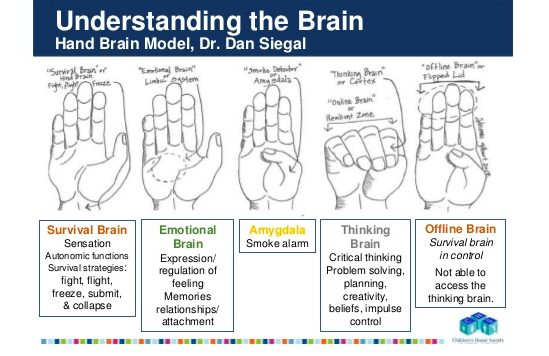
Dr. Daniel Siegal developed the “Hand Model of the Brain” to explain our brain structure, functionality and why it’s difficult to control our actions when stressed or overwhelmed.
Key parts of the brain structure using The Hand Model:

1. Wrist = Brain Stem. The wrist represents the spinal cord that is connected to the brain stem.
- The Brain Stem also known as the “Reptilian Brain,” controls our animalistic instincts such as hunger and desires – survival instinct (fight or flight). IT is responsible for basic regulatory functions such as regulating body temperature, digestion, lung function, swallowing, and heart rate. It maintains the energy level for other body parts.
- The arm = Spine. Messages carried from hand to rest of the body.

2. Thumb = Limbic System To create the view of the brain, thumb gets folded into the open palm.
- The limbic system is considered the “Emotional Hub,” where we process all our emotions and store memories. The limbic system is responsible for our behavioural and emotional responses, especially when it comes to behaviour we need for survival.
- The amygdala (at the tip of the thumb) is part of the limbic system that acts as a safety sensor that drives the ‘flight-or-fight’ response. When triggered it sends signal to brain stem to take over and assess event. Associated with fear, the amygdala prompts an instant survival response that drives us to act without thinking which may be crucial to survival.

3. The Fingers = Cerebral Cortex. To create the view of the brain in neutral state, fold fingers over thumb. The Prefrontal Cortex (fingertips) connect and allows a flow of communication between the brainstem and limbic system (thumb and wrist).
- The Cerebral Cortex is the thinking and decision-making part of the brain. These areas are responsible for the higher-level processes of the human brain including language, memory, reasoning, thought, learning, decision-making, emotion, intelligence, and personality.
- Key NOTE: To think, feel and do things intentionally we need the fingers of our Handy Brain Model to be engaged.

4. KEY POINT: FLIPPING THE LID: When we ‘Flip the Lid’, the fingers go straight up showing that our thinking brain (fingers) is completely disengaged (from brain stem, reptilian brain is left in charge).
KEY LEARN: When our stress level gets too high, we’re exhausted or we feel threatened, the primitive area of our brain geared toward survival takes over and disconnects the thinking part of our brain that reasons, plans and makes intentional decisions.
We essentially turn on our flight-or-fight mechanism and our survival mode takes over:
- We can’t process information
- We do not have empathy as we are not really hearing what the other person is saying
- We have tunnel vision, so we get ‘stuck’ in our story, repeating our position.
- We can’t effectively solve problems.
- KEY NOTE: When our amygdala is activated and ancient brain is in control, our survival instincts take over and we cannot make rational conscious decisions.
Learn directly from Dr. Dan Siegel here.
Why it matters?
- Understanding the key components of the brain and their response to fight-or-flight mechanism being triggered helps us
- Knowledge of the key parts of the brain (in simplest terms) helps us understand our emotional mechanisms. Understanding these brain components will allow us to self-regulate by paying attention to the signals our body produces. In doing so, we can learn how to deal with them effectively.
How?
Knowledge is power – now we can work to:
1. Keep the Lid On: Prevent the disconnection from happening, when possible.
How to Keep the Lid ON:
- Find Your Triggers. Identify your patterns (through Daily I.Liv. Assess practice and Thought Work habit) and prepare for them in advance.
- Beware of Your Indicators. Some indications that may be about to “flip our lid” include feeling flushed, cold or shaky, sweating, panting, numb or tingly, having a pounding heart, tightly clenched jaws, and angry tears. Sometimes, these extreme frustrations can manifest as screaming or losing control.
- Physically move away from situation and take deep breaths. Deep breathing can reduce the adrenal feeling of the “fight” response, fueling the upper brain with oxygen, so it can take over, calm down the lower brain, and let us revaluate our position.
- Regular self-care habits help to keep our brain running in calmer state and make us less prone to flip our lids.
2. Minimize ‘damage’ while lid is off: If we recognize we are triggered, we can remove our selves from situations or avoid unintentional reactions.
How to Minimize the Damage while Lid is OFF – Take a PAUSE!
- Recognize you Flipped Your Lid. Once we ‘Flip our Lid’ we might get symptoms like:
- Racing heart
- Tight fists
- Dilated pupils
- Shallow, rapid breathing
- Tense muscles
- Pause. Have ready-made reasons to remove yourself from the situation and take a step back, even if momentarily.
- Ex. Always Works: Bathroom break; Get a drink of Water; Grab something from the car.
- Ex. Phrases:
- ‘I will get back to you tomorrow morning’,
- Wow. ‘That’s great input/ interesting / valid points. Let me think about that and get back to you.’, etc.
Note: You may need at least 20 minutes to calm down and get yourself back to thinking mode.
3. Put the lid back on: To reconnect our thinking brain we need to calm-down our triggered ancient reptile brain.
How to put the Lid back ON – Develop ‘Calm-Down’ Toolkit:
- Breathe. Breathing is the top technique for reducing an emotional response quickly. Have a favorite breathing technique ready-to-go.
- Get Fresh Air. Nature and natural air movement calm us down. Go outside, walk around and check out nature (visual scanning to show your body there is no danger, vs in danger our pupils dialate, so we need to constrict eyes), focus on details in the distance – pin point specific (that’s what dialate) .
- Move. Simply move your body by jumping up and down on the spot, taking a brisk walk or doing some stretches or easy yoga postures.
- Calming activity. Take part in any activity you personally find calming (ex. knitting, stress ball, play with our hair, etc.)
- Visualization. Use mental imagery to picture yourself in a calming location. Get our brain focused back in, versus out.
Reference: [1]